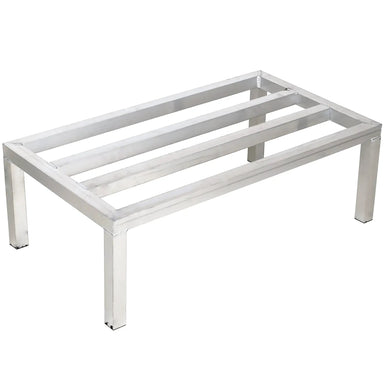
Phoenix Aluminum Dunnage Racks - Various Sizes
Phoenix gives you stable, long lasting products at a fraction of the cost. Use the Phoenix dunnage racks to store large produce bags away from dirt...
View full details
Save %
Phoenix gives you stable, long lasting products at a fraction of the cost. Use the Phoenix dunnage racks to store large produce bags away from dirt...
View full detailsA dunnage rack lifts bulk cases, bagged goods, and sacks off a walk-in or storage room floor — the standard fix for meeting health codes that require food kept off the floor. Our Phoenix Aluminum Dunnage Rack comes in eight size combinations, pairing 14" or 20" depths with 24", 36", 48", or 60" lengths at a fixed 12" height, so it fits almost any storage bay. Aluminum resists rust far better than uncoated steel in a wet, washed-down walk-in. Phoenix Food Equipment ships dunnage racks from Vaughan across the GTA — Toronto and Mississauga included — and nationwide across Canada.
Common questions from operators buying this kind of equipment.
Depth and length are the two dimensions that matter for a dunnage rack, since the height is fixed. The Phoenix Aluminum Dunnage Rack comes in 14" or 20" depths, paired with 24", 36", 48", or 60" lengths — eight combinations in total, all sitting at a 12" clearance off the floor. A narrower 14" rack fits against a wall with limited floor space, while the 20" depth suits a wider aisle or a rack meant to hold larger cases and bags. Length should match what's actually being stored: a 24" rack works for a single case or two of product, while the 60" option handles a full pallet-width row of bagged goods along a wall.
Aluminum holds up better than uncoated or painted steel in the kind of environment a dunnage rack usually sits in — a walk-in cooler, freezer, or dry storage room that gets mopped, hosed down, or exposed to condensation regularly. Painted steel can chip and rust once the coating wears through, especially at the welds, while aluminum resists corrosion without a coating to maintain. It's also lighter, which matters when a rack needs to be moved or repositioned during a deep clean. The tradeoff is that stainless steel dunnage racks cost more but handle even heavier, more abrasive loads — for most walk-in and dry storage use, aluminum is the practical middle ground.
A dunnage rack and a shelf both lift product off the floor, but they're built for different loads. A shelf is meant for smaller, individually placed items — cans, boxes, or prepped ingredients — arranged across a flat surface, often at multiple heights. A dunnage rack sits low, usually around 12 inches off the floor, and is built to carry a single layer of bulk, heavy items like sacks of flour, cases of canned goods, or stacked bags, spread across slats rather than a solid shelf. If it's bulk storage sitting directly on a walk-in or dry storage floor, a dunnage rack is the fix; if it's smaller items that need organizing at eye level or within reach, a shelf is the better tool.